CMCTECH · SOLUTION PROPOSAL

The design changed, but did the production criteria change as well?

Comparison with Business Standards

Issues to checkRequired management criteria
Mixing old and new drawings and BOMsApproval configuration for products, BOMs, drawings, and documents
Difference between change notification and actual applicationEffective date·time, first LOT, and inventory handling conditions
Unverified response after supplier receiptHistory distinguishing receipt, implementation plan, and supplementary response
Scattered evidence for development approvalLinking requirements, testing, first articles, and customer approval to product revisions

Product revision and change implementation · meaning and judgment

The design team approved Revision B, but purchasing may order A and the shop floor may follow a previous work instruction. A change is reflected in the product only when the supplier’s implementation readiness has also been confirmed.

The review items for “Mixing old and new drawings and BOMs” are as follows. Required management criteria: approval configuration for products, BOMs, drawings, and documents.

The review items for “Difference between change notification and actual application” are as follows. Required management criteria: effective date·time, first LOT, and inventory handling conditions.

Order of On-Site Implementation and Acceptance Testing

  1. Confirming the roles of design, purchasing, quality, production, and suppliers
  2. Comparing source records based on product number
  3. Confirm Exception Handling and Approval Evidence
  4. Validate Results Using a Representative Case

Product revision and change implementation · execution and inspection

The review items for “Unverified response after supplier receipt” are as follows. Required management criteria: history distinguishing receipt, implementation plan, and supplementary response.

The review items for “Scattered evidence for development approval” are as follows. Required management criteria: linking requirements, testing, first articles, and customer approval to product revisions.

When reviewing this chapter’s “The design changed, but did the production criteria change as well?”, read product number, drawing revision, BOM, and change effective time using the same criteria. Those responsible for design, purchasing, quality, production, and suppliers must check not only the values they enter, but also the information received from the preceding step and the status to be passed to the next step.
CMC TECH · Product Development·Collaboration1 / 18
CMCTECH · SOLUTION PROPOSAL

Internal product criteria: PLM; supplier execution linkage: WSP

Criteria for linking product revisions and change implementation

Connection CriteriaItems to Check
Product numberCheck Entries and Change History on the Same Basis
Drawing revisionCheck Entries and Change History on the Same Basis
BOMCheck Entries and Change History on the Same Basis
Change effective timeCheck Entries and Change History on the Same Basis

Product revision and change implementation · meaning and judgment

Using EIMS product·material·BOM master data as the basis, manage drawing revisions, approval configurations, EO·ECN, and development stages.

Deliver change documents and implementation conditions to affected suppliers, and link responses for receipt, implementation plans, and requested materials.

PLM and WSP are connected directly. SCM is not used as an intermediary system for supplier notifications. The scope of automatic reflection·holding in ERP·MES will be finalized after confirming the customer system’s interfaces and operating rules.

Order of On-Site Implementation and Acceptance Testing

  1. Confirming the roles of design, purchasing, quality, production, and suppliers
  2. Comparing source records based on product number
  3. Confirm Exception Handling and Approval Evidence
  4. Validate Results Using a Representative Case

Product revision and change implementation · execution and inspection

When reviewing this chapter’s “Internal product criteria: PLM; supplier execution linkage: WSP,” read product number, drawing revision, BOM, and change effective time using the same criteria. Those responsible for design, purchasing, quality, production, and suppliers must check not only the values they enter, but also the information received from the preceding step and the status to be passed to the next step.
Check cases in which changes, cancellations, or omissions occur, along with normal processing results. Record where judgments differ among design, purchasing, quality, production, and suppliers, and agree on who will approve them and on what basis. Any automation scope that cannot be confirmed from existing materials should remain a review item before implementation.

CMC TECH · Product Development·Collaboration2 / 18
CMCTECH · SOLUTION PROPOSAL

The connector specifications have changed. Where does the responsible person process what? · 1

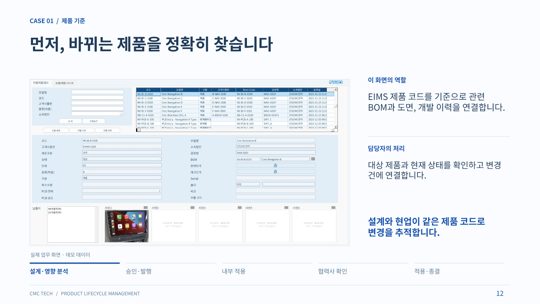
EIMS Product Master Data · Demo Screen

EIMS Product Master Data · Demo Screen
Previously Published Demonstration Materials · Implementation Screens and Scope to Be Finalized After Business Review

Product revision and change implementation · meaning and judgment

The following is an example workflow assuming a component change in an electrical module. Link everything from product selection through the supplier’s response to the same change case.

Situation: The product containing the changed component must match the product code used by the relevant business function. After confirming the target and impact scope, determine the reason for the change, approval, and implementation conditions.

Confirmed result: The person in charge can see in the same history what is being changed, why it is being changed, and which criteria will be applied.

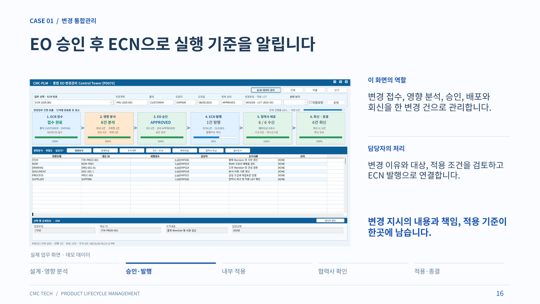
EO Integrated Change Management · Demo Screen

EO Integrated Change Management · Demo Screen
Previously Published Demonstration Materials · Implementation Screens and Scope to Be Finalized After Business Review

Product revision and change implementation · execution and inspection

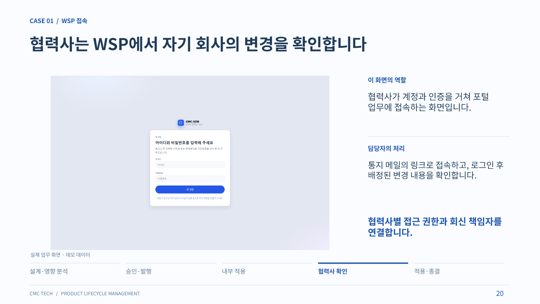
We sent an update email, but we do not yet know whether the supplier can make the change on schedule. We confirm the required recipients and collect receipt confirmations and implementation plans separately in WSP.

Confirmed result: It is clear who received the request and under what conditions they agreed to make the change. The change is closed after supplementary actions and internal confirmation are completed.

A reduced view of the actual program's demo screen is shown. The sample data on the screen is not actual performance data from a specific customer. Detailed enlargement and original-file downloads are not provided.

CMC TECH · Product Development·Collaboration3 / 18
CMCTECH · SOLUTION PROPOSAL

The connector specification has changed. Where does the person in charge handle what? · 2

WSP Supplier Access · Demo Screen

WSP Supplier Access · Demo Screen
Previously Published Demonstration Materials · Implementation Screens and Scope to Be Finalized After Business Review

Product revision and change implementation · meaning and judgment

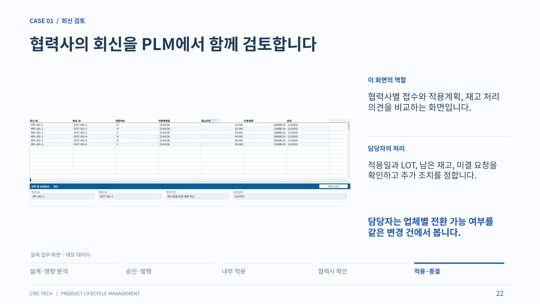
Design approval and the supplier's actual implementation are different statuses. The change-in-scope and excluded items must be distinguished, and the disposition of quantities already purchased or produced must also be decided.

For a single change request, compare the approved criteria, the suppliers that received the request, the implementation plans they returned, and when the change was reflected in production.

PLM Supplier Response Review · Demo Screen

PLM Supplier Response Review · Demo Screen
Previously Published Demonstration Materials · Implementation Screens and Scope to Be Finalized After Business Review

Product revision and change implementation · execution and inspection

When reviewing “The connector specification has changed. Where does the person in charge handle what?” in this chapter, product numbers, drawing revisions, BOMs, and the change effective date must be interpreted using the same criteria. Those responsible for design, purchasing, quality, production, and suppliers must verify not only the values they enter, but also the information received from the preceding stage and the status passed to the next stage.

Check cases in which changes, cancellations, or omissions occur, along with normal processing results. Record where judgments differ among design, purchasing, quality, production, and suppliers, and agree on who will approve them and on what basis. Any automation scope that cannot be confirmed from existing materials should remain a review item before implementation.

CMC TECH · Product Development·Collaboration4 / 18
CMCTECH · SOLUTION PROPOSAL

Schedule and quality evidence lead to production approval

Comparison with Business Standards

Development StageEvidence to Review Together
Customer Requirements · Development PlanDevelopment product, schedule, responsible person, design and verification items
APQP·P1·P2Gate deliverables, missing tasks, prototype and test-sample results
Testing · ISIR · PSOTest revision, initial-production LOT, equipment, material, and operator readiness
PPAP · After Production LaunchCustomer submission, conditional approval actions, and 4M change history

Product revision and change implementation · meaning and judgment

Request supplier deliverables through WSP and link the responses to the relevant development task. Align stage definitions and approval conditions with the customer's development procedures.

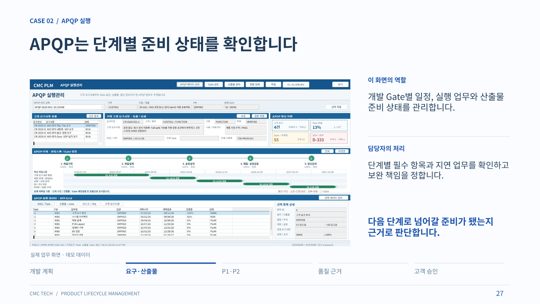
Assess not only the progress shown in the schedule, but also whether the evidence needed to move to the next stage is ready.

The review items for “Customer Requirements · Development Plan” are as follows. Evidence to review together: development product, schedule, responsible person, and design and verification items.

APQP Stage Execution · Demo Screen

APQP Stage Execution · Demo Screen
Previously Published Demonstration Materials · Implementation Screens and Scope to Be Finalized After Business Review

Product revision and change implementation · execution and inspection

The review items for “APQP · P1 · P2” are as follows. Evidence to review together: Gate deliverables, missing tasks, and prototype and test-sample results.

The review items for “Testing · ISIR · PSO” are as follows. Evidence to review together: test revision, initial-production LOT, and equipment, material, and operator readiness.

The review items for “PPAP · After Production Launch” are as follows. Evidence to review together: customer submission, conditional approval actions, and 4M change history.

CMC TECH · Product Development·Collaboration5 / 18
CMCTECH · SOLUTION PROPOSAL

Start with the Required Management Scope

Criteria for linking product revisions and change implementation

Connection CriteriaItems to Check
Product numberCheck Entries and Change History on the Same Basis
Drawing revisionCheck Entries and Change History on the Same Basis
BOMCheck Entries and Change History on the Same Basis
Change effective timeCheck Entries and Change History on the Same Basis

Product revision and change implementation · meaning and judgment

First establish internal product standards and the development and change approval framework.

Link lower-tier supplier receipt confirmations and implementation plans with supplementary materials.

This expansion plan checks PLM's effective revision, ECN, inventory disposition, supplier readiness, and development approval conditions before placing an order. The criteria for warnings, holds, and exception approvals will be finalized in the future integration design; this is within the planned implementation scope.

Design approval and the supplier's actual implementation are different statuses. The change-in-scope and excluded items must be distinguished, and the disposition of quantities already purchased or produced must also be decided.

Order of On-Site Implementation and Acceptance Testing

  1. Confirming the roles of design, purchasing, quality, production, and suppliers
  2. Comparing source records based on product number
  3. Confirm Exception Handling and Approval Evidence
  4. Validate Results Using a Representative Case

Product revision and change implementation · execution and inspection

When reviewing “Start with the Required Management Scope” in this chapter, product numbers, drawing revisions, BOMs, and the change effective date must be interpreted using the same criteria. Those responsible for design, purchasing, quality, production, and suppliers must verify not only the values they enter, but also the information received from the preceding stage and the status passed to the next stage.

Check cases in which changes, cancellations, or omissions occur, along with normal processing results. Record where judgments differ among design, purchasing, quality, production, and suppliers, and agree on who will approve them and on what basis. Any automation scope that cannot be confirmed from existing materials should remain a review item before implementation.

CMC TECH · Product Development·Collaboration6 / 18
CMCTECH · SOLUTION PROPOSAL

Departments and Suppliers Make Decisions Based on the Same Product

Criteria for linking product revisions and change implementation

Connection CriteriaItems to Check
Product numberCheck Entries and Change History on the Same Basis
Drawing revisionCheck Entries and Change History on the Same Basis
BOMCheck Entries and Change History on the Same Basis
Change effective timeCheck Entries and Change History on the Same Basis

Product revision and change implementation · meaning and judgment

Design verifies the approved configuration, production and materials verify the implementation conditions, and quality verifies the testing and approval evidence. Suppliers verify their execution tasks and response responsibilities.

Using your representative products and change cases as a basis, we can jointly review your current workflow and the required scope of integration.

Design approval and the supplier's actual implementation are different statuses. The change-in-scope and excluded items must be distinguished, and the disposition of quantities already purchased or produced must also be decided.

Order of On-Site Implementation and Acceptance Testing

  1. Confirming the roles of design, purchasing, quality, production, and suppliers
  2. Comparing source records based on product number
  3. Confirm Exception Handling and Approval Evidence
  4. Validate Results Using a Representative Case

Product revision and change implementation · execution and inspection

When reviewing “Departments and Suppliers Make Decisions Based on the Same Product” in this chapter, product numbers, drawing revisions, BOMs, and the change effective date must be interpreted using the same criteria. Those responsible for design, purchasing, quality, production, and suppliers must verify not only the values they enter, but also the information received from the preceding stage and the status passed to the next stage.

Check cases in which changes, cancellations, or omissions occur, along with normal processing results. Record where judgments differ among design, purchasing, quality, production, and suppliers, and agree on who will approve them and on what basis. Any automation scope that cannot be confirmed from existing materials should remain a review item before implementation.

CMC TECH · Product Development·Collaboration7 / 18
CMCTECH · SOLUTION PROPOSAL

Changes to Automotive Electrical Products Do Not End with Document Distribution

Criteria for linking product revisions and change implementation

Connection CriteriaItems to Check
Product numberCheck Entries and Change History on the Same Basis
Drawing revisionCheck Entries and Change History on the Same Basis
BOMCheck Entries and Change History on the Same Basis
Change effective timeCheck Entries and Change History on the Same Basis

Product revision and change implementation · meaning and judgment

For products such as controllers, navigation systems, and clusters, where hardware and software change together, the approved configuration may differ even when the part number is the same. First, product revisions, BOMs, drawings, test results, and implementation conditions must be grouped under the same change request. The integration between the software configuration and test equipment will be determined after confirming the tools used by the customer and the scope of integration.

CMC-PLM connects internal product standards and change approval tasks, while WSP connects supplier receipt confirmations, implementation plans, and material responses. Separating the approved criteria from the criteria actually applied makes it possible to identify gaps where “the change was communicated, but the site did not change.”

Order of On-Site Implementation and Acceptance Testing

  1. Confirming the roles of design, purchasing, quality, production, and suppliers
  2. Comparing source records based on product number
  3. Confirm Exception Handling and Approval Evidence
  4. Validate Results Using a Representative Case

Product revision and change implementation · execution and inspection

At implementation, select one representative product and one recent change. Follow the process from the approval document through the supplier response and the first applied LOT, distinguishing records that currently exist from records that need to be newly linked.

When reviewing “Changes to Automotive Electrical Products Do Not End with Document Distribution” in this chapter, product numbers, drawing revisions, BOMs, and the change effective date must be interpreted using the same criteria. Those responsible for design, purchasing, quality, production, and suppliers must verify not only the values they enter, but also the information received from the preceding stage and the status passed to the next stage.

CMC TECH · Product Development·Collaboration8 / 18
CMCTECH · SOLUTION PROPOSAL

Design Change Impact Scope: Distinguish What to Change from What to Keep · 1

Comparison with Business Standards

TargetItems to CheckBasis for Decision
Product · BOMCommon parts · Effective revisionList of affected models
Inventory · Work in processConditions for use, sorting, and modificationQuality approval
Orders · SuppliersExisting orders · Conversion timingReceipt confirmation · Implementation plan
Shop-floor instructionsBoundary between old and new criteriaFirst applied LOT

Product revision and change implementation · meaning and judgment

Let's consider a hypothetical case in which the connector specification changes. The review must cover not only the design drawing, but also models using common parts, semifinished products, inventory, orders already issued, and production instructions in progress. Without confirming the product configuration and effective date, the scope of the change may become unnecessarily broad or some items may be missed.

Do not decide in advance to scrap all existing inventory. Quality and design review the conditions under which it can be used as is, used after sorting or modification, or handled separately. Record the decision basis and approvers in the change request and ensure that materials and production see the same conditions.

Order of On-Site Implementation and Acceptance Testing

  1. Confirming the roles of design, purchasing, quality, production, and suppliers
  2. Comparing source records based on product number
  3. Confirm Exception Handling and Approval Evidence
  4. Validate Results Using a Representative Case

Product revision and change implementation · execution and inspection

Automatic inventory holds or order restrictions require the interfaces and approval rules to be designed separately. At the proposal stage, first confirm the impact list and handling criteria, then agree on the level of automation.

The review items for “Product · BOM” are as follows. Items to confirm: common parts · effective revision; basis for decision: list of affected models.

The review items for “Inventory · Work in Process” are as follows. Items to confirm: conditions for use, sorting, and modification; basis for decision: quality approval.

CMC TECH · Product Development·Collaboration9 / 18
CMCTECH · SOLUTION PROPOSAL

Design Change Impact Scope: Distinguish What to Change from What to Keep · 2

Criteria for linking product revisions and change implementation

Connection CriteriaItems to Check
Product numberCheck Entries and Change History on the Same Basis
Drawing revisionCheck Entries and Change History on the Same Basis
BOMCheck Entries and Change History on the Same Basis
Change effective timeCheck Entries and Change History on the Same Basis

Product revision and change implementation · meaning and judgment

The review items for “Orders · Suppliers” are as follows. Items to confirm: existing orders · conversion timing; basis for decision: receipt confirmation · implementation plan.

The review items for “Shop-floor Instructions” are as follows. Items to confirm: boundary between old and new criteria; basis for decision: first applied LOT.

Design approval and the supplier's actual implementation are different statuses. The change-in-scope and excluded items must be distinguished, and the disposition of quantities already purchased or produced must also be decided.

Order of On-Site Implementation and Acceptance Testing

  1. Confirming the roles of design, purchasing, quality, production, and suppliers
  2. Comparing source records based on product number
  3. Confirm Exception Handling and Approval Evidence
  4. Validate Results Using a Representative Case

Product revision and change implementation · execution and inspection

When reviewing “Design Change Impact Scope: Distinguish What to Change from What to Keep” in this chapter, product numbers, drawing revisions, BOMs, and the change effective date must be interpreted using the same criteria. Those responsible for design, purchasing, quality, production, and suppliers must verify not only the values they enter, but also the information received from the preceding stage and the status passed to the next stage.

Check cases in which changes, cancellations, or omissions occur, along with normal processing results. Record where judgments differ among design, purchasing, quality, production, and suppliers, and agree on who will approve them and on what basis. Any automation scope that cannot be confirmed from existing materials should remain a review item before implementation.

CMC TECH · Product Development·Collaboration10 / 18
CMCTECH · SOLUTION PROPOSAL

Divide Change Status into Four Stages

Criteria for linking product revisions and change implementation

Connection CriteriaItems to Check
Product numberCheck Entries and Change History on the Same Basis
Drawing revisionCheck Entries and Change History on the Same Basis
BOMCheck Entries and Change History on the Same Basis
Change effective timeCheck Entries and Change History on the Same Basis

Product revision and change implementation · meaning and judgment

Change approval, material distribution, supplier receipt confirmation, and shop-floor implementation are different statuses. If approval completed is marked as implementation completed, delays and outstanding items will be hidden. A key part of implementation is defining who verifies what at each status.

When reviewing responses in WSP, check not only whether the request was received, but also the possible implementation date, the supplier's inventory position, and any required testing or approval materials. Supplementary requests and subsequent responses must be tracked under the same change number to reduce the risk of retaining only the final response.

Design approval and the supplier's actual implementation are different statuses. The change-in-scope and excluded items must be distinguished, and the disposition of quantities already purchased or produced must also be decided.

Order of On-Site Implementation and Acceptance Testing

  1. Confirming the roles of design, purchasing, quality, production, and suppliers
  2. Comparing source records based on product number
  3. Confirm Exception Handling and Approval Evidence
  4. Validate Results Using a Representative Case

Product revision and change implementation · execution and inspection

Closure does not mean that all related tasks finish on the same date. Design the operating procedure so that outstanding risks and temporary approval conditions are confirmed, and items requiring follow-up review retain an assigned person and due date.

When reviewing “Divide Change Status into Four Stages” in this chapter, product numbers, drawing revisions, BOMs, and the change effective date must be interpreted using the same criteria. Those responsible for design, purchasing, quality, production, and suppliers must verify not only the values they enter, but also the information received from the preceding stage and the status passed to the next stage.

CMC TECH · Product Development·Collaboration11 / 18
CMCTECH · SOLUTION PROPOSAL

Separate the Scope Shown to Suppliers from Internal Permissions · 1

Comparison with Business Standards

RoleKey ResponsibilitiesVerification Conditions
DesignPrepare Standards · Change ProposalDistinguish Approved Configurations
QualityVerify Validation · Approval EvidenceManage Conditional Approvals
Purchasing · MaterialsCoordinate Conversion ConditionsCheck Existing Orders · Inventory
SupplierRespond with Receipt Confirmation · Implementation PlanAccess Only the Assigned Scope

Product revision and change implementation · meaning and judgment

Even when multiple suppliers participate in one product, the part numbers, documents, and response targets visible to each company differ. Configure the system after confirming each company's access permissions and assigned-task scope, and ensure that internal review comments are not confused with the external response screen.

When a person in charge leaves the company or a supplier changes, access permissions must be revoked and the work handed over. Also review separately the permission to modify already approved documents and the permission to register a new revision.

Design approval and the supplier's actual implementation are different statuses. The change-in-scope and excluded items must be distinguished, and the disposition of quantities already purchased or produced must also be decided.

Order of On-Site Implementation and Acceptance Testing

  1. Confirming the roles of design, purchasing, quality, production, and suppliers
  2. Comparing source records based on product number
  3. Confirm Exception Handling and Approval Evidence
  4. Validate Results Using a Representative Case

Product revision and change implementation · execution and inspection

During acceptance testing, access the same link using accounts from different companies to verify that the materials are separated. Check the scopes for viewing and responding, as well as receipt history and records of changes to the person in charge, in accordance with the customer's security policy.

The review items for “Design” are as follows. Main task: prepare standards · change proposal; verification condition: distinguish approved configurations.

The review items for “Quality” are as follows. Main task: verify validation · approval evidence; verification condition: manage conditional approvals.

CMC TECH · Product Development·Collaboration12 / 18
CMCTECH · SOLUTION PROPOSAL

Separate the Scope Shown to Suppliers from Internal Permissions · 2

Criteria for linking product revisions and change implementation

Connection CriteriaItems to Check
Product numberCheck Entries and Change History on the Same Basis
Drawing revisionCheck Entries and Change History on the Same Basis
BOMCheck Entries and Change History on the Same Basis
Change effective timeCheck Entries and Change History on the Same Basis

Product revision and change implementation · meaning and judgment

The review items for “Purchasing · Materials” are as follows. Main task: coordinate conversion conditions; verification condition: check existing orders · inventory.

The review points for “Supplier” are as follows. Key task: respond with receipt confirmation and an implementation plan; access condition: access only the assigned scope.

Design approval and the supplier's actual implementation are different statuses. The change-in-scope and excluded items must be distinguished, and the disposition of quantities already purchased or produced must also be decided.

Order of On-Site Implementation and Acceptance Testing

  1. Confirming the roles of design, purchasing, quality, production, and suppliers
  2. Comparing source records based on product number
  3. Confirm Exception Handling and Approval Evidence
  4. Validate Results Using a Representative Case

Product revision and change implementation · execution and inspection

When reviewing “Separate the scope shown to suppliers from internal permissions” in this chapter, read the product number, drawing revision, BOM, and change effective date using the same criteria. Those responsible for design, purchasing, quality, production, and suppliers should verify not only the values they enter, but also the information received from the preceding stage and the status passed to the next stage.

Check cases in which changes, cancellations, or omissions occur, along with normal processing results. Record where judgments differ among design, purchasing, quality, production, and suppliers, and agree on who will approve them and on what basis. Any automation scope that cannot be confirmed from existing materials should remain a review item before implementation.

CMC TECH · Product Development·Collaboration13 / 18
CMCTECH · SOLUTION PROPOSAL

Pre-production Gate: Review prepared evidence rather than progress percentage

Criteria for linking product revisions and change implementation

Connection CriteriaItems to Check
Product numberCheck Entries and Change History on the Same Basis
Drawing revisionCheck Entries and Change History on the Same Basis
BOMCheck Entries and Change History on the Same Basis
Change effective timeCheck Entries and Change History on the Same Basis

Product revision and change implementation · meaning and judgment

Even when the development schedule shows a high completion rate, it is difficult to decide whether to move to mass production if required test results or customer approval documents are missing. Review the APQP deliverables, responsible persons, and approval conditions in each stage in connection with the product revision.

If the BOM used for prototypes and test units differs from the BOM planned for mass production, verify whether the test results can be applied as they are. If any parts or processes have changed, clearly document the scope of additional validation and outstanding tasks.

Design approval and the supplier's actual implementation are different statuses. The change-in-scope and excluded items must be distinguished, and the disposition of quantities already purchased or produced must also be decided.

Order of On-Site Implementation and Acceptance Testing

  1. Confirming the roles of design, purchasing, quality, production, and suppliers
  2. Comparing source records based on product number
  3. Confirm Exception Handling and Approval Evidence
  4. Validate Results Using a Representative Case

Product revision and change implementation · execution and inspection

CMC TECH first confirms the customer’s development procedures and terminology. Rather than uniformly imposing every stage, including APQP, testing, initial samples, and PPAP, CMC TECH agrees on the required Gates and supporting evidence as part of the implementation scope.

When reviewing “Pre-production Gate: Review prepared evidence rather than progress percentage” in this chapter, read the product number, drawing revision, BOM, and change effective date using the same criteria. Those responsible for design, purchasing, quality, production, and suppliers should verify not only the values they enter, but also the information received from the preceding stage and the status passed to the next stage.

CMC TECH · Product Development·Collaboration14 / 18
CMCTECH · SOLUTION PROPOSAL

Compare before and after implementation through connected records · 1

Comparison with Business Standards

WorkBefore implementationPoints to verify after implementation
Change criteriaVerify by file name and emailProduct, revision, and approval item
SupplierFocus on whether notification was sentDistinguish receipt confirmation from implementation planning
Mass-production readinessProgress reportVerify deliverables and outstanding conditions
Post-implementation reviewRely on the person responsible’s memoryTrace the evidence for changes and implementation

Product revision and change implementation · meaning and judgment

Under the existing approach, drawing files, change emails, supplier responses, and test data are scattered across different folders. Using the change number and product revision as common criteria allows a new person responsible to identify which materials need to be reviewed together.

The improvement goal is not simply to store more documents. It is to quickly identify gaps between the current approval criteria, the supplier’s implementation readiness, and the evidence of actual implementation, and then decide on the next action.

Design approval and the supplier's actual implementation are different statuses. The change-in-scope and excluded items must be distinguished, and the disposition of quantities already purchased or produced must also be decided.

Order of On-Site Implementation and Acceptance Testing

  1. Confirming the roles of design, purchasing, quality, production, and suppliers
  2. Comparing source records based on product number
  3. Confirm Exception Handling and Approval Evidence
  4. Validate Results Using a Representative Case

Product revision and change implementation · execution and inspection

Performance can be assessed not only by the number of days required to process changes, but also by the rate of supplementary responses, omissions in implementation conditions, and instances of using superseded drawings. The aggregation criteria and baseline period are agreed upon at project initiation; no improvement rate is guaranteed in advance.

The review points for “Change criteria” are as follows. Before implementation: verify by file name and email; points to verify after implementation: product, revision, and approval item.

The review points for “Supplier” are as follows. Before implementation: focus on whether notification was sent; points to verify after implementation: distinguish receipt confirmation from implementation planning.

CMC TECH · Product Development·Collaboration15 / 18
CMCTECH · SOLUTION PROPOSAL

Compare before and after implementation through connected records · 2

Criteria for linking product revisions and change implementation

Connection CriteriaItems to Check
Product numberCheck Entries and Change History on the Same Basis
Drawing revisionCheck Entries and Change History on the Same Basis
BOMCheck Entries and Change History on the Same Basis
Change effective timeCheck Entries and Change History on the Same Basis

Product revision and change implementation · meaning and judgment

The review points for “Mass-production readiness” are as follows. Before implementation: progress report; points to verify after implementation: verify deliverables and outstanding conditions.

The review points for “Post-implementation review” are as follows. Before implementation: rely on the person responsible’s memory; points to verify after implementation: trace the evidence for changes and implementation.

Design approval and the supplier's actual implementation are different statuses. The change-in-scope and excluded items must be distinguished, and the disposition of quantities already purchased or produced must also be decided.

Order of On-Site Implementation and Acceptance Testing

  1. Confirming the roles of design, purchasing, quality, production, and suppliers
  2. Comparing source records based on product number
  3. Confirm Exception Handling and Approval Evidence
  4. Validate Results Using a Representative Case

Product revision and change implementation · execution and inspection

When reviewing “Compare before and after implementation through connected records” in this chapter, read the product number, drawing revision, BOM, and change effective date using the same criteria. Those responsible for design, purchasing, quality, production, and suppliers should verify not only the values they enter, but also the information received from the preceding stage and the status passed to the next stage.

Check cases in which changes, cancellations, or omissions occur, along with normal processing results. Record where judgments differ among design, purchasing, quality, production, and suppliers, and agree on who will approve them and on what basis. Any automation scope that cannot be confirmed from existing materials should remain a review item before implementation.

CMC TECH · Product Development·Collaboration16 / 18
CMCTECH · SOLUTION PROPOSAL

Validate using one representative change · 1

Comparison with Business Standards

Validation caseVerification result
Common-part changeVerify all affected models
Supplier delayDistinguish not received from no response
Change to implementation datePreserve existing and new conditions
Change of person responsibleRevoke permissions and hand over responsibilities

Product revision and change implementation · meaning and judgment

A validation case should not consist solely of one routine change. It should also include real-world exceptions such as common parts, purchase orders already issued, delayed supplier responses, and changes to the implementation date.

View the same change from the perspectives of design, quality, purchasing, and the supplier. Verify that each role can see the criteria it needs and does not mistake unapproved content for the basis for execution.

Design approval and the supplier's actual implementation are different statuses. The change-in-scope and excluded items must be distinguished, and the disposition of quantities already purchased or produced must also be decided.

Order of On-Site Implementation and Acceptance Testing

  1. Confirming the roles of design, purchasing, quality, production, and suppliers
  2. Comparing source records based on product number
  3. Confirm Exception Handling and Approval Evidence
  4. Validate Results Using a Representative Case

Product revision and change implementation · execution and inspection

Validation results should record not only a pass indicator, but also the master data and operating procedures requiring improvement. Initially, it is appropriate to limit the scope to one product group and essential suppliers, then expand it after confirming an operationally viable process.

The review points for “Common-part change” are as follows. Verification result: verify all affected models.

The review points for “Supplier delay” are as follows. Verification result: distinguish not received from no response.

The review points for “Change to implementation date” are as follows. Verification result: preserve existing and new conditions.

CMC TECH · Product Development·Collaboration17 / 18
CMCTECH · SOLUTION PROPOSAL

Validate using one representative change · 2

Criteria for linking product revisions and change implementation

Connection CriteriaItems to Check
Product numberCheck Entries and Change History on the Same Basis
Drawing revisionCheck Entries and Change History on the Same Basis
BOMCheck Entries and Change History on the Same Basis
Change effective timeCheck Entries and Change History on the Same Basis

Product revision and change implementation · meaning and judgment

The review points for “Change of person responsible” are as follows. Verification result: revoke permissions and hand over responsibilities.

Design approval and the supplier's actual implementation are different statuses. The change-in-scope and excluded items must be distinguished, and the disposition of quantities already purchased or produced must also be decided.

For a single change request, compare the approved criteria, the suppliers that received the request, the implementation plans they returned, and when the change was reflected in production.

Order of On-Site Implementation and Acceptance Testing

  1. Confirming the roles of design, purchasing, quality, production, and suppliers
  2. Comparing source records based on product number
  3. Confirm Exception Handling and Approval Evidence
  4. Validate Results Using a Representative Case

Product revision and change implementation · execution and inspection

When reviewing “Validate using one representative change” in this chapter, read the product number, drawing revision, BOM, and change effective date using the same criteria. Those responsible for design, purchasing, quality, production, and suppliers should verify not only the values they enter, but also the information received from the preceding stage and the status passed to the next stage.

Check cases in which changes, cancellations, or omissions occur, along with normal processing results. Record where judgments differ among design, purchasing, quality, production, and suppliers, and agree on who will approve them and on what basis. Any automation scope that cannot be confirmed from existing materials should remain a review item before implementation.