2. Why the Digital Value Chain
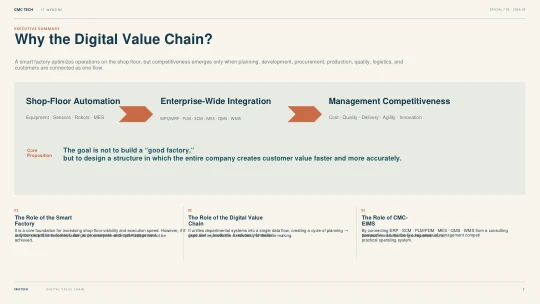
First, let us look at the overall flow of this presentation. A smart factory is an important foundation for improving visibility into equipment and shop-floor operations. To turn shop-floor performance into company-wide performance, this must be connected with demand, product standards, and supply availability. For example, even if production speed increases, customer delivery dates cannot be met if the required materials arrive late. CMC-EIMS designs these connections between departments from the perspective of integrated digitalization for manufacturing companies. We focus on the business characteristics of electronics and SMT, semiconductor, and semiconductor equipment manufacturing, while the same principles can be applied to other manufacturing industries.
Using a representative customer order as the basis, we trace when information between departments is created, approved, and transferred, and first validate the points where the connections break.
When reviewing this chapter, “Why the Digital Value Chain,” read customer requirements, product standards, planning, purchasing, production, quality, and shipping against the same standards. Personnel responsible for sales, design, planning, purchasing, production, and quality should check not only the values they enter, but also the information received from the previous stage and the status to be passed to the next stage.
Confirm cases involving changes, cancellations, and omissions along with normal processing results. Record where judgments differ among sales, design, planning, purchasing, production, and quality, and agree on who will approve them and on what basis. Any automation scope that cannot be verified using existing materials should remain an item for review before implementation.
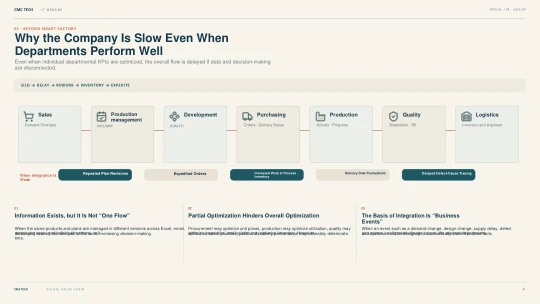
The purchasing department successfully reduced unit prices, and the production department increased its utilization rate. But if inventory is building up and emergency transportation costs are rising, what should you examine? You need to look beyond departmental results and examine the entire path through which an order flows. Bulk purchases may have arrived earlier than planned, or the production sequence may have differed from customer priorities. When related departments review business events such as demand changes, supply delays, and design changes using the same standards, the starting point for responding changes. Connectivity is more than a convenience for moving between screens; it is about aligning responsibility and judgment.
Using a representative customer order as the basis, we trace when information between departments is created, approved, and transferred, and first validate the points where the connections break.
When reviewing this chapter, “Why the Company Is Slow Even When Departments Perform Well,” read customer requirements, product standards, planning, purchasing, production, quality, and shipping against the same standards. Personnel responsible for sales, design, planning, purchasing, production, and quality should check not only the values they enter, but also the information received from the previous stage and the status to be passed to the next stage.
Confirm cases involving changes, cancellations, and omissions along with normal processing results. Record where judgments differ among sales, design, planning, purchasing, production, and quality, and agree on who will approve them and on what basis. Any automation scope that cannot be verified using existing materials should remain an item for review before implementation.
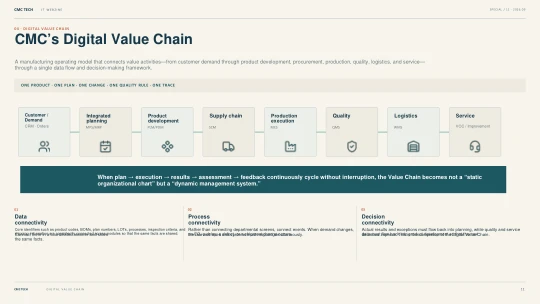
CMC TECH's digital value chain is an operating model that connects operations from customer demand through service into a single decision flow. Having the same product code is not enough. You also need to know which BOM version applies, which order and plan it relates to, and which quality standards were used for approval. When demand changes, planning and supply are reviewed again; when actual results differ, they are reflected in the next plan. This connection does not require replacing every system at once. After reviewing current master data, interfaces, and areas of responsibility, implementation can begin with the necessary segments.
Using a representative customer order as the basis, we trace when information between departments is created, approved, and transferred, and first validate the points where the connections break.
When reviewing this chapter, “CMC's Definition of the Digital Value Chain,” read customer requirements, product standards, planning, purchasing, production, quality, and shipping against the same standards. Personnel responsible for sales, design, planning, purchasing, production, and quality should check not only the values they enter, but also the information received from the previous stage and the status to be passed to the next stage.
Confirm cases involving changes, cancellations, and omissions along with normal processing results. Record where judgments differ among sales, design, planning, purchasing, production, and quality, and agree on who will approve them and on what basis. Any automation scope that cannot be verified using existing materials should remain an item for review before implementation.
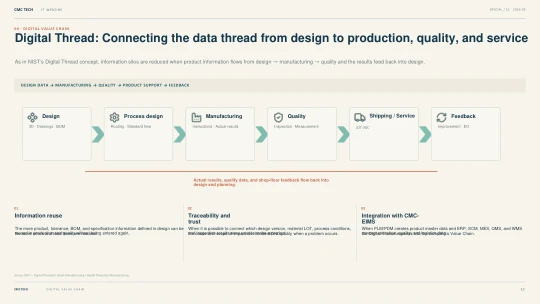
The digital thread is useful for describing how product information remains connected across design, manufacturing, and quality. Related NIST research also addresses the exchange of information in which design information is used in manufacturing and inspection, with the results fed back into design. In CMC TECH's implementation, it provides the link connecting items and BOMs with processes and inspection criteria. The fact that a drawing file was delivered is different from the shop floor having worked from the correct revision. The product version, effective date, and actual usage results must be connected so that all departments can maintain a consistent account of the same product.
Using a representative customer order as the basis, we trace when information between departments is created, approved, and transferred, and first validate the points where the connections break.
When reviewing this chapter, “Digital Thread: Connecting the Data Thread from Design to Production, Quality, and Service,” read customer requirements, product standards, planning, purchasing, production, quality, and shipping against the same standards. Personnel responsible for sales, design, planning, purchasing, production, and quality should check not only the values they enter, but also the information received from the previous stage and the status to be passed to the next stage.
Confirm cases involving changes, cancellations, and omissions along with normal processing results. Record where judgments differ among sales, design, planning, purchasing, production, and quality, and agree on who will approve them and on what basis. Any automation scope that cannot be verified using existing materials should remain an item for review before implementation.
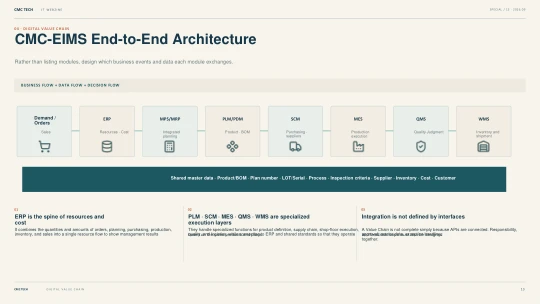
When viewing the architecture, focus on the data being connected rather than the number of modules. ERP manages flows of quantities and amounts; PLM manages product and change standards; and MPS and MRP manage production preparation. SCM and WSP connect supplier collaboration, while MES connects shop-floor execution. Quality and logistics are also included in this flow. Based on common item and planning numbers, determine who creates and who uses each piece of data. Whether to apply automatic approvals or automatic controls should be confirmed within each customer's implementation scope. Interface connections and the actual completion conditions of business processes must be designed together.
Using a representative customer order as the basis, we trace when information between departments is created, approved, and transferred, and first validate the points where the connections break.
When reviewing this chapter, “CMC-EIMS End-to-End Architecture,” read customer requirements, product standards, planning, purchasing, production, quality, and shipping against the same standards. Personnel responsible for sales, design, planning, purchasing, production, and quality should check not only the values they enter, but also the information received from the previous stage and the status to be passed to the next stage.
Confirm cases involving changes, cancellations, and omissions along with normal processing results. Record where judgments differ among sales, design, planning, purchasing, production, and quality, and agree on who will approve them and on what basis. Any automation scope that cannot be verified using existing materials should remain an item for review before implementation.
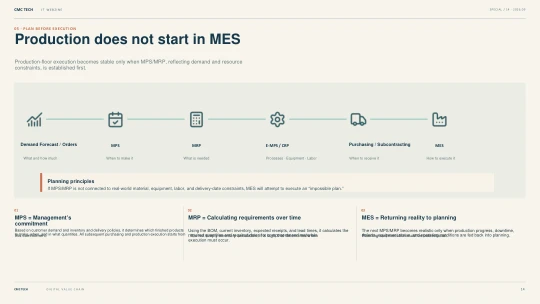
For production preparation, we first examine MPS and MRP automation. You must determine what to make, when to make it, and in what quantity, then calculate which materials are needed and when for that plan. In E-MPS, planning and capacity review by process are important. Production cannot proceed simply because equipment is available. The workforce, including the required operators, qualifications, and shifts, must also be checked. By creating a realistic plan in this way and receiving actual results and exceptions from MES, planning accuracy can be improved. Traceability is an important foundation for reliably connecting the execution results that follow.
Using a representative customer order as the basis, we trace when information between departments is created, approved, and transferred, and first validate the points where the connections break.
When reviewing this chapter, “Production Does Not Start in MES,” read customer requirements, product standards, planning, purchasing, production, quality, and shipping against the same standards. Personnel responsible for sales, design, planning, purchasing, production, and quality should check not only the values they enter, but also the information received from the previous stage and the status to be passed to the next stage.
Confirm cases involving changes, cancellations, and omissions along with normal processing results. Record where judgments differ among sales, design, planning, purchasing, production, and quality, and agree on who will approve them and on what basis. Any automation scope that cannot be verified using existing materials should remain an item for review before implementation.
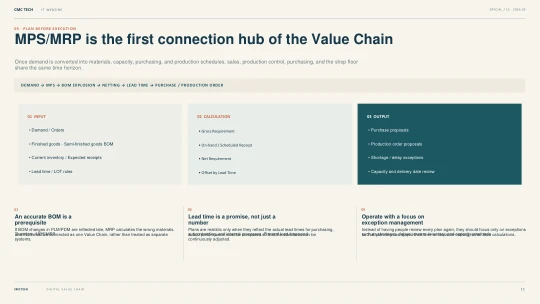
Let us look more closely at the MRP calculation flow. Based on demand and the BOM, gross requirements are calculated first; on-hand inventory and scheduled receipts are then reflected to calculate net requirements. Applying lead times and lot-sizing rules makes it possible to determine when purchasing or production should be prepared. The calculation results should lead to review and approval by the person responsible. Whether to place an order when materials are short, postpone the plan, or consider an alternative depends on the business conditions. The value of automation lies in reducing the time spent repeating calculations and allowing personnel to focus on exceptions and choices.
Using a representative customer order as the basis, we trace when information between departments is created, approved, and transferred, and first validate the points where the connections break.
When reviewing this chapter, “MPS/MRP: The First Connection Hub in the Value Chain,” read customer requirements, product standards, planning, purchasing, production, quality, and shipping against the same standards. Personnel responsible for sales, design, planning, purchasing, production, and quality should check not only the values they enter, but also the information received from the previous stage and the status to be passed to the next stage.
Confirm cases involving changes, cancellations, and omissions along with normal processing results. Record where judgments differ among sales, design, planning, purchasing, production, and quality, and agree on who will approve them and on what basis. Any automation scope that cannot be verified using existing materials should remain an item for review before implementation.
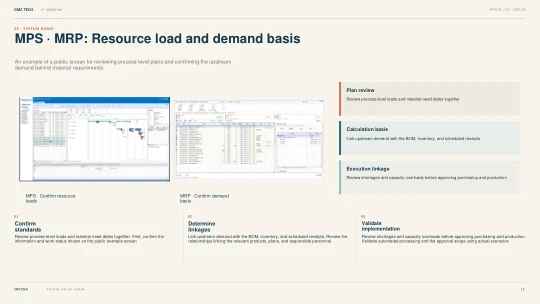
The screens actually deployed are examples of reviewing MPS resource loads and the basis for MRP requirements. First, examine the schedule and load to see which resources the plan is concentrated on. Then confirm which upper-level demand generated the material requirements. The reason for viewing both screens together is to avoid deciding production dates and purchasing quantities separately. The examples shown on the screens are public materials intended to explain the functionality and decision sequence. The extent to which this information is automatically reflected in purchasing approvals and shop-floor work instructions will be validated according to the actual implementation scope.
Using a representative customer order as the basis, we trace when information between departments is created, approved, and transferred, and first validate the points where the connections break.
When reviewing this chapter, “MPS · MRP: Resource Load and Basis for Requirements,” read customer requirements, product standards, planning, purchasing, production, quality, and shipping against the same standards. Personnel responsible for sales, design, planning, purchasing, production, and quality should check not only the values they enter, but also the information received from the previous stage and the status to be passed to the next stage.
Confirm cases involving changes, cancellations, and omissions along with normal processing results. Record where judgments differ among sales, design, planning, purchasing, production, and quality, and agree on who will approve them and on what basis. Any automation scope that cannot be verified using existing materials should remain an item for review before implementation.
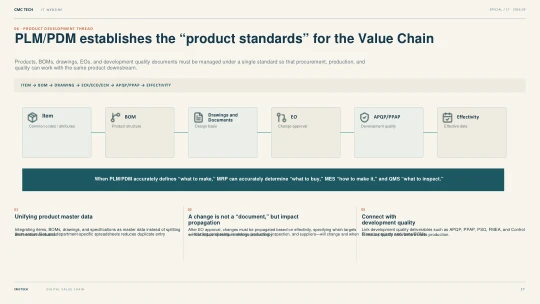
In PLM and PDM, product standards are aligned first. If the same item is registered under different names or BOM revisions are maintained separately, subsequent calculations and execution may become misaligned. Product structures and drawings, change histories, and development quality materials are linked to the relevant items and projects. MRP can then calculate based on the correct material structure, while the shop floor and inspection teams can use standards appropriate to the product. Organizing standards before mass production is not merely a documentation convenience; it is preparation for preventing purchasing and production errors.
Using a representative customer order as the basis, we trace when information between departments is created, approved, and transferred, and first validate the points where the connections break.
When reviewing this chapter, “PLM/PDM Creates the ‘Product Standards’ of the Value Chain,” read customer requirements, product standards, planning, purchasing, production, quality, and shipping against the same standards. Personnel responsible for sales, design, planning, purchasing, production, and quality should check not only the values they enter, but also the information received from the previous stage and the status to be passed to the next stage.
Confirm cases involving changes, cancellations, and omissions along with normal processing results. Record where judgments differ among sales, design, planning, purchasing, production, and quality, and agree on who will approve them and on what basis. Any automation scope that cannot be verified using existing materials should remain an item for review before implementation.
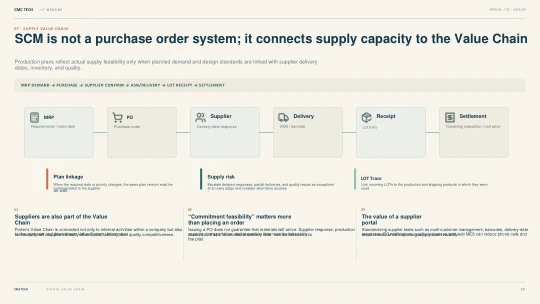
SCM feeds supply availability back into planning. Sending a purchase order does not guarantee that the required materials will arrive by the required date. You must confirm supplier delivery responses, partial deliveries, and the time required for inspection and receipt. The work of notifying suppliers of changes and quality materials through WSP and receiving their responses can also be viewed as part of the same collaboration flow. Change collaboration through PLM and WSP and purchasing linkage through SCM should be designed with their implementation scopes distinguished. Rather than assuming that every connection is already complete functionality, validate them step by step against the actual suppliers' operations and data conditions.
Using a representative customer order as the basis, we trace when information between departments is created, approved, and transferred, and first validate the points where the connections break.
When reviewing this chapter, “SCM Is Not an Ordering System but a System That Connects Supply Capacity to the Value Chain,” read customer requirements, product standards, planning, purchasing, production, quality, and shipping against the same standards. Personnel responsible for sales, design, planning, purchasing, production, and quality should check not only the values they enter, but also the information received from the previous stage and the status to be passed to the next stage.
Confirm cases involving changes, cancellations, and omissions along with normal processing results. Record where judgments differ among sales, design, planning, purchasing, production, and quality, and agree on who will approve them and on what basis. Any automation scope that cannot be verified using existing materials should remain an item for review before implementation.
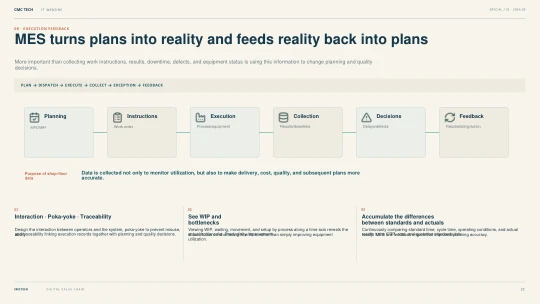
MES executes plans and reports actual results back. The shop-floor capabilities emphasized by CMC TECH are interaction, foolproofing, and traceability. Operators must be able to understand the next action and communicate with the system, while the use of incorrect materials or sequences must be prevented. Execution histories must be linked to products and processes. On this basis, feeding stoppages, defects, and progress variances back into MPS and MRP enables the next plan to reflect reality. The purpose of data collection is not to fill screens, but to change the next decision.
Using a representative customer order as the basis, we trace when information between departments is created, approved, and transferred, and first validate the points where the connections break.
When reviewing this chapter, “MES Turns Plans into Reality and Feeds Reality Back into Plans,” read customer requirements, product standards, planning, purchasing, production, quality, and shipping against the same standards. Personnel responsible for sales, design, planning, purchasing, production, and quality should check not only the values they enter, but also the information received from the previous stage and the status to be passed to the next stage.
Confirm cases involving changes, cancellations, and omissions along with normal processing results. Record where judgments differ among sales, design, planning, purchasing, production, and quality, and agree on who will approve them and on what basis. Any automation scope that cannot be verified using existing materials should remain an item for review before implementation.
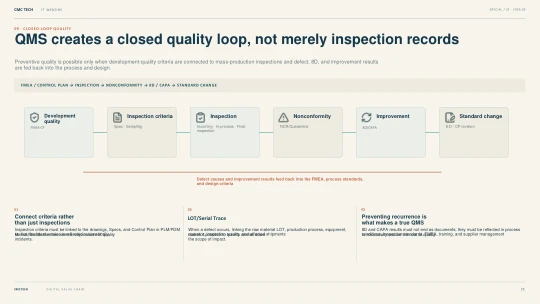
Quality connectivity does not end with storing inspection results. It must continue through which standards were used for inspection, which products may be affected when a problem occurs, and whether improvement results were reflected in subsequent standards. This is why connecting risk reviews during development with inspections during mass production is important. When a defect is found, identify and isolate the affected items, then analyze the cause. Afterward, confirm whether corrective actions were reflected in work standards, inspection criteria, and supplier management. Documentation of all actions must be managed separately from the actual change to the standards.
Using a representative customer order as the basis, we trace when information between departments is created, approved, and transferred, and first validate the points where the connections break.
When reviewing this chapter, “QMS Creates a Quality Closed Loop, Not Just Inspection Records,” read customer requirements, product standards, planning, purchasing, production, quality, and shipping against the same standards. Personnel responsible for sales, design, planning, purchasing, production, and quality should check not only the values they enter, but also the information received from the previous stage and the status to be passed to the next stage.
Confirm cases involving changes, cancellations, and omissions along with normal processing results. Record where judgments differ among sales, design, planning, purchasing, production, and quality, and agree on who will approve them and on what basis. Any automation scope that cannot be verified using existing materials should remain an item for review before implementation.
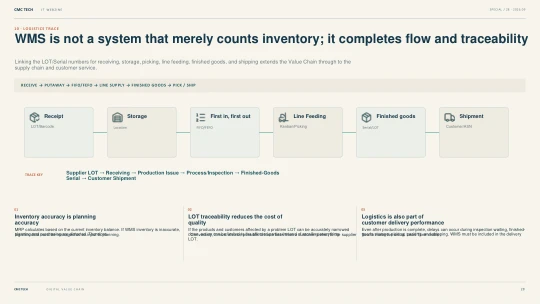
Logistics information is also an input to production planning. Even if a quantity appears in the books, it may not be inventory currently available for use if it is on inspection hold or allocated to another order. MRP calculations can be trusted only when locations, statuses, and LOTs are distinguished and actual movements are recorded. After production is complete, inspection waiting time, packing, picking, and shipping also affect customer delivery dates. That is why logistics is not viewed merely as an ancillary task at the end of production. The flow of the same order is tracked through the actual point of completion when it is delivered to the customer.
Using a representative customer order as the basis, we trace when information between departments is created, approved, and transferred, and first validate the points where the connections break.
When reviewing this chapter, “WMS Completes Flow and Traceability, Rather Than Merely Counting Inventory,” read customer requirements, product standards, planning, purchasing, production, quality, and shipping against the same standards. Personnel responsible for sales, design, planning, purchasing, production, and quality should check not only the values they enter, but also the information received from the previous stage and the status to be passed to the next stage.
Confirm cases involving changes, cancellations, and omissions along with normal processing results. Record where judgments differ among sales, design, planning, purchasing, production, and quality, and agree on who will approve them and on what basis. Any automation scope that cannot be verified using existing materials should remain an item for review before implementation.
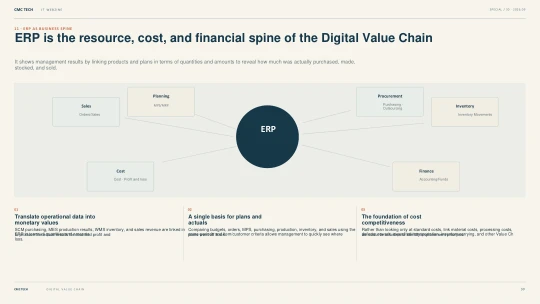
ERP connects operational quantities with monetary values. What was purchased, how much was produced, how much inventory remains, and which sales it led to form the basis for costs and profit and loss. Field data and financial figures must be able to explain one another. AiFi can connect this organized management information to comparison and inquiry. However, interpretation must follow verification of the data period, accounts, and closing status. A structure that can explain the financial impact of operational changes is the foundation for decision-making.
Using a representative customer order as the basis, we trace when information between departments is created, approved, and transferred, and first validate the points where the connections break.
When reviewing this chapter, “ERP is the Resource, Cost, and Finance Spine of the Digital Value Chain,” read customer requirements, product standards, planning, purchasing, production, quality, and shipping on the same basis. Those responsible for sales, design, planning, purchasing, production, and quality should check not only the values they enter, but also the information received from the previous stage and the status passed to the next stage.
Confirm cases involving changes, cancellations, and omissions along with normal processing results. Record where judgments differ among sales, design, planning, purchasing, production, and quality, and agree on who will approve them and on what basis. Any automation scope that cannot be verified using existing materials should remain an item for review before implementation.
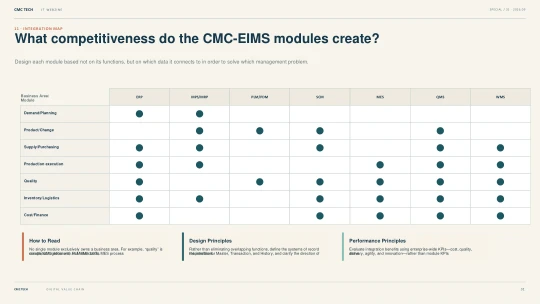
This table is a map for understanding the relationship between modules and business processes. Do not interpret each dot as an installation-completion indicator or a guarantee of automatic integration; view it as a point where related processes meet. For example, quality can be explained only when product standards, process execution, inspection decisions, and material history are available together. It is necessary to determine which system establishes the standard for each data item and whether other systems will only read it or also be allowed to modify it. Stable integration requires not only reducing duplicate entry, but also being able to determine which value is authoritative when different values arise.
Using a representative customer order as the basis, we trace when information between departments is created, approved, and transferred, and first validate the points where the connections break.
When reviewing this chapter, “What Competitiveness Do the CMC-EIMS Modules Create?”, read customer requirements, product standards, planning, purchasing, production, quality, and shipping on the same basis. Those responsible for sales, design, planning, purchasing, production, and quality should check not only the values they enter, but also the information received from the previous stage and the status passed to the next stage.
Confirm cases involving changes, cancellations, and omissions along with normal processing results. Record where judgments differ among sales, design, planning, purchasing, production, and quality, and agree on who will approve them and on what basis. Any automation scope that cannot be verified using existing materials should remain an item for review before implementation.
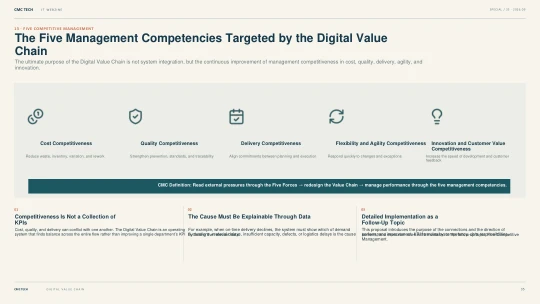
We will now organize the outcomes of the Digital Value Chain into five competencies: cost, quality, delivery, flexibility and agility, and innovation and customer value. These should not simply be maximized independently. A choice to reduce inventory may increase delivery risk, while rush production may create a quality burden. Management’s role is to view connected data and assess these trade-offs. This presentation introduces the criteria for interpreting the results. Detailed methods for building screens and execution rules for each competency will be covered in subsequent topics.
Using a representative customer order as the basis, we trace when information between departments is created, approved, and transferred, and first validate the points where the connections break.
When reviewing this chapter, “The Five Management Competencies Targeted by the Digital Value Chain,” read customer requirements, product standards, planning, purchasing, production, quality, and shipping on the same basis. Those responsible for sales, design, planning, purchasing, production, and quality should check not only the values they enter, but also the information received from the previous stage and the status passed to the next stage.
Confirm cases involving changes, cancellations, and omissions along with normal processing results. Record where judgments differ among sales, design, planning, purchasing, production, and quality, and agree on who will approve them and on what basis. Any automation scope that cannot be verified using existing materials should remain an item for review before implementation.
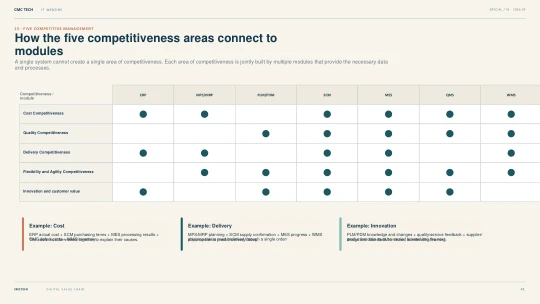
Let us look again at the relationship between the five competencies and the modules. Explaining cost requires data on purchasing, production, quality, and inventory. Explaining delivery requires connections between planning and supply, the shop floor and shipping. Innovation, too, cannot be completed with information from the development department alone. This table is not a list stating that purchasing particular software immediately creates a particular competency. It is an implementation map that organizes which data should be viewed together. In a detailed implementation of Five Competitive Management, the indicator formulas and responsibilities, screens, and action rules will be defined separately.
Using a representative customer order as the basis, we trace when information between departments is created, approved, and transferred, and first validate the points where the connections break.
When reviewing this chapter, “How the Five Competencies Connect with the Modules,” read customer requirements, product standards, planning, purchasing, production, quality, and shipping on the same basis. Those responsible for sales, design, planning, purchasing, production, and quality should check not only the values they enter, but also the information received from the previous stage and the status passed to the next stage.
Confirm cases involving changes, cancellations, and omissions along with normal processing results. Record where judgments differ among sales, design, planning, purchasing, production, and quality, and agree on who will approve them and on what basis. Any automation scope that cannot be verified using existing materials should remain an item for review before implementation.
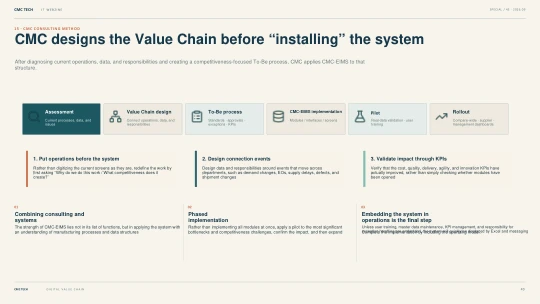
Implementation begins with diagnosing current processes and data. We identify where orders are delayed, who creates product standards, and how changes are communicated. We then define the business events and responsibilities to connect, along with approval and exception rules, and apply the necessary modules. CMC TECH proposes an approach that considers manufacturing workflows and systems together. During the pilot, cases such as changes and delays, holds and cancellations must be tested in addition to the normal flow. User training and operating standards must become established for the new connections to become the actual standard way of working.
Using a representative customer order as the basis, we trace when information between departments is created, approved, and transferred, and first validate the points where the connections break.
When reviewing this chapter, “CMC Designs the Value Chain Before ‘Installing’ the System,” read customer requirements, product standards, planning, purchasing, production, quality, and shipping on the same basis. Those responsible for sales, design, planning, purchasing, production, and quality should check not only the values they enter, but also the information received from the previous stage and the status passed to the next stage.
Confirm cases involving changes, cancellations, and omissions along with normal processing results. Record where judgments differ among sales, design, planning, purchasing, production, and quality, and agree on who will approve them and on what basis. Any automation scope that cannot be verified using existing materials should remain an item for review before implementation.
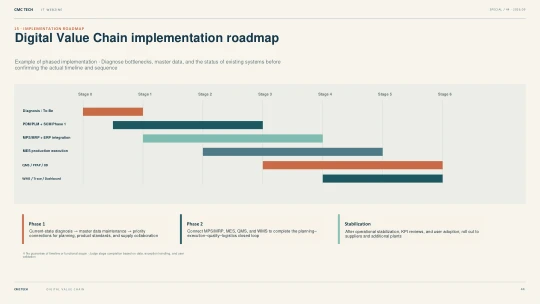
The roadmap is an example explaining preparation and validation by stage, not a schedule that guarantees a timeframe. First, organize current processes and master data, and prioritize reviewing connections among planning, product standards, and supplier collaboration. Then connect feedback from production execution, quality, and logistics, and verify operating results. The actual sequence may vary depending on the company’s biggest bottleneck and the condition of its existing systems. The criteria for moving to the next stage are not limited to calendar dates. Also verify whether data consistency, exception handling, user execution, and recovery procedures have been validated.
Using a representative customer order as the basis, we trace when information between departments is created, approved, and transferred, and first validate the points where the connections break.
When reviewing this chapter, “Digital Value Chain Implementation Roadmap,” read customer requirements, product standards, planning, purchasing, production, quality, and shipping on the same basis. Those responsible for sales, design, planning, purchasing, production, and quality should check not only the values they enter, but also the information received from the previous stage and the status passed to the next stage.
Confirm cases involving changes, cancellations, and omissions along with normal processing results. Record where judgments differ among sales, design, planning, purchasing, production, and quality, and agree on who will approve them and on what basis. Any automation scope that cannot be verified using existing materials should remain an item for review before implementation.
| Connection Criteria | Items to Check |
|---|---|
| Customer Requirements | Check Entries and Change History on the Same Basis |
| Product Standards | Check Entries and Change History on the Same Basis |
| Planning | Check Entries and Change History on the Same Basis |
| Purchasing | Check Entries and Change History on the Same Basis |
Even if actual production results are collected accurately, delivery problems will recur if the work to be produced and the required materials are not prepared. First connect demand to MPS and E-MPS process-level plans, then connect CRP equipment and labor capacity reviews with MRP checks for material shortages.
PLM product standards and change conditions form the basis for planning calculations. Supplier delivery confirmations supplement the feasibility of material preparation, while actual MES progress provides variances to review in the next plan. The key is ensuring that each system sees the same product and timing.
Planning automation and execution control will be applied in stages according to the customer’s master data and interfaces. Before replacing all existing systems, a representative order can be used to identify where the workflow breaks.
When reviewing this chapter, “The Digital Value Chain Starts with MPS and MRP Automation,” read customer requirements, product standards, planning, purchasing, production, quality, and shipping on the same basis. Those responsible for sales, design, planning, purchasing, production, and quality should check not only the values they enter, but also the information received from the previous stage and the status passed to the next stage.
| Connection Criteria | Items to Verify |
|---|---|
| Identifiers | Order · Item · Revision · LOT |
| Timing | Approval · Effective Date · Closing Criteria |
| Errors | Resubmission · Duplicates · Partial Failures |
| Responsibility | Source System · Person Responsible for Changes |
If the same product is registered under different codes in different systems, it is difficult to trace actual events even when reports are consolidated. First define which keys will link orders, items, revisions, production orders, material LOTs, and shipping units.
Integration does not end with sending data once. Rules are needed to handle duplicate application upon resubmission, partial failures, cancellations and corrections, and changes after closing. Also clarify the source system for master data and the person responsible for modifications.
Validation should cover both the normal flow of a representative order and change and cancellation cases. Document in the operating procedure which screen is used to check an error and who performs recovery.
The review items for “Identifiers” are as follows. Items to verify: Order · Item · Revision · LOT.
The review items for “Timing” are as follows. Items to verify: Approval · Effective Date · Closing Criteria.
The review items for “Errors” are as follows. Items to verify: Resubmission · Duplicates · Partial Failures.
The review items for “Responsibility” are as follows. Items to verify: Source System · Person Responsible for Changes.